
Because “Gen Z” is the most visible signal of a deeper transformation. This book uses Generation Z as an entry point to explore a broader shift in how organizations operate. What leaders often interpret as a generational problem, disengagement, lack of loyalty, or high turnover, is in reality a reaction to outdated management systems. The title reflects this tension: Gen Z is not the subject of the book, but the trigger that makes structural issues impossible to ignore.
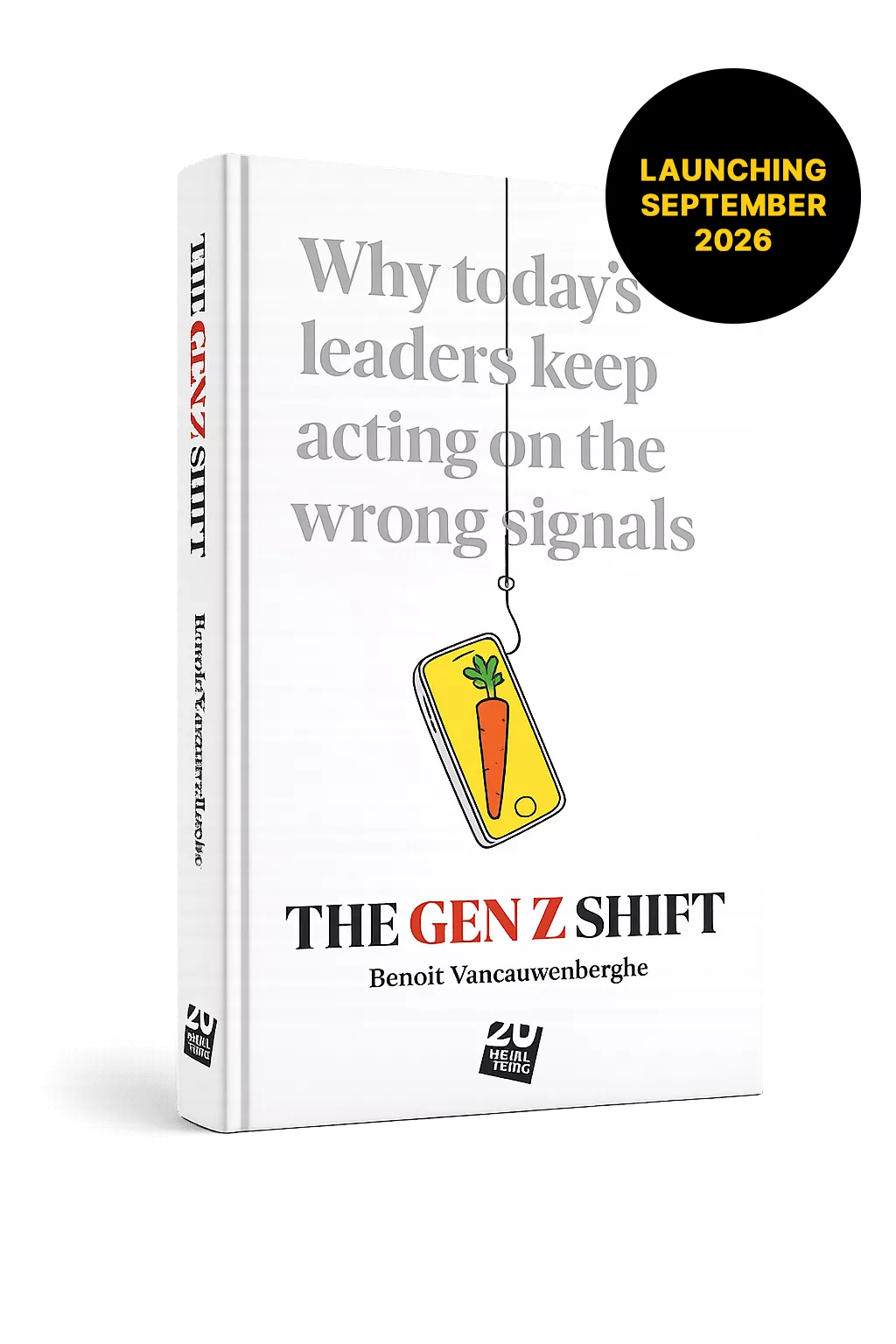
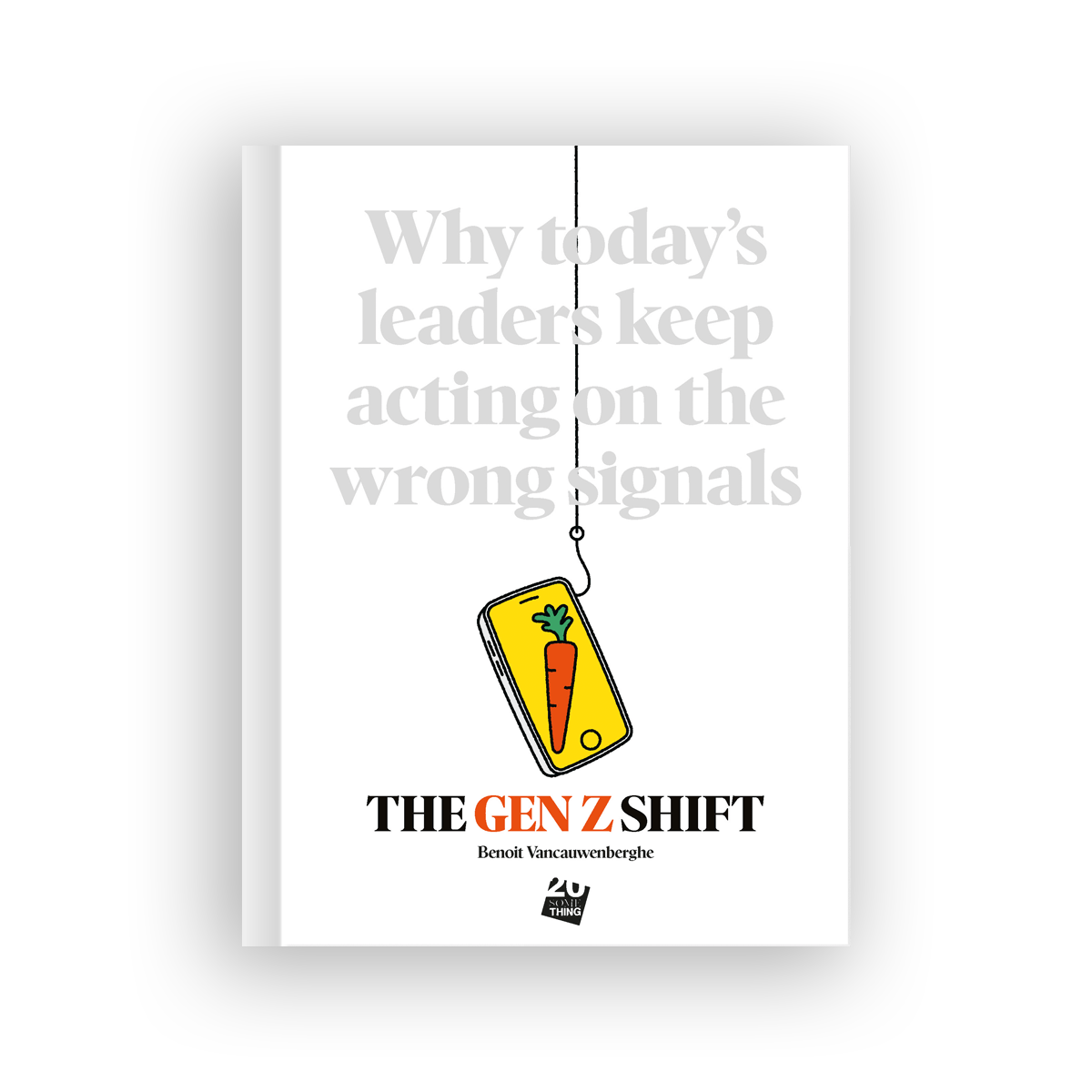
THE GEN Z SHIFT
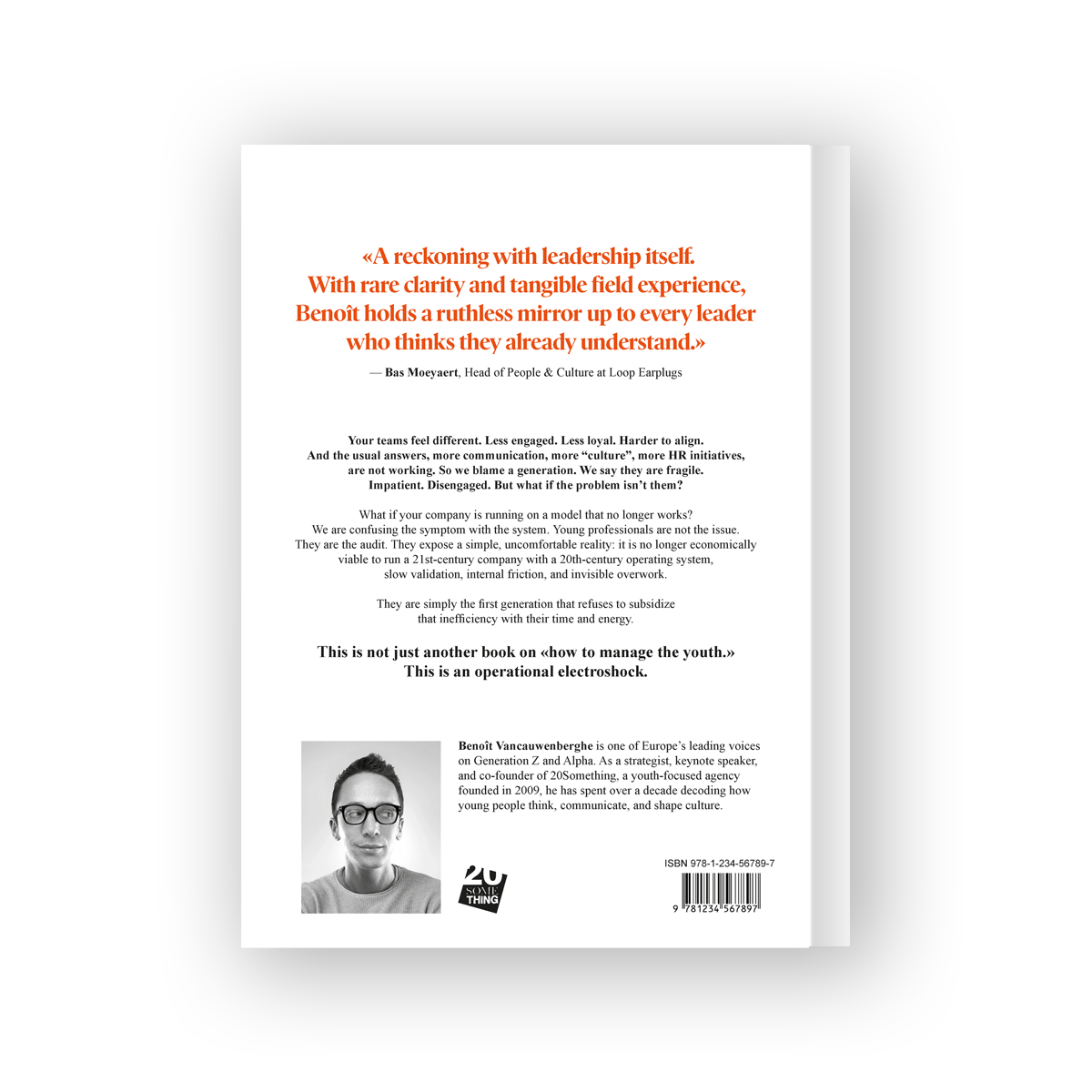
“A reckoning with leadership itself. With rare clarity and tangible field experience, Benoît holds a ruthless mirror up to every leader who thinks they already understand.”
— Bas Moeyaert, Head of People & Culture at Loop Earplugs
This is not just another HR book.
This is an operational electroshock.
Your teams feel different. Less engaged. Less loyal. Harder to align.
And the usual answers, more communication, more “culture”, more HR initiatives, are not working. So we blame a generation. We say they are fragile. Impatient. Disengaged. But what if the problem isn’t them?
What if your company is running on a model that no longer works? We are confusing the symptom with the system. Young professionals are not the issue. They are the audit. They expose a simple, uncomfortable reality: it is no longer economically viable to run a 21st-century company with a 20th-century operating system, slow validation, internal friction, and invisible overwork.
They are simply the first generation that refuses to subsidize that inefficiency with their time and energy.
The Gen Z Shift is not a book about managing a generation. It is a book about upgrading the way you run your organization. Stop trying to fix people. Start fixing the system.
What early readers are saying
about the book
The Gen Z Shift is a reckoning with leadership itself. With rare clarity and tangible field experience, Benoît holds a ruthless mirror up to every leader who thinks they already understand. He reframes generational tension as an architectural challenge; a test of our existing systems, assumptions, and ideas about authority, engagement, and loyalty within a professional context. Extremely confronting, compelling, and surprisingly direct: this book challenges your thinking and changes how you lead. And how you see yourself within that system.
Bas Moeyaert, Head of People & Culture, Loop Earplugs
Benoit’s The Gen Z Shift serves as an uncompromising mirror for today’s leaders, reframing generational friction as a structural “glitch” in our architecture rather than a character flaw. Synthesizing high-level corporate insights with rigorous research, he uses recognizable scenarios to replace obsolete reflexes with shared clarity. This efficient, mission-focused guide empowers you to pivot from a defensive posture to leading high-speed intelligence through radical change. If you seek to lead the future rather than manage the past, this is the strategic compass you didn’t realize you were missing.
Lesley Peeters, MSc Eng, Superior Officer in the Belgian Armed Forces, Pilot and Aviation Safety Expert
This book is just wonderful. I loved reading it. I spent like 20 minutes talking to my friend yesterday about your idea of companies relying on unpaid extra labor from employees and then calling it “being a family”. It’s just so well thought out and put together. The book does such a wonderful job of articulating the functional differences between the generational cultures. So often I feel like generational conversations are had with these big, vague, broad-brush criticisms. You actually present the ideas as cogent, provable trends. It’s great.
Donovan Wolfington, voice actor, Los Angeles
“Youth Expert” to
“Leadership Auditor”
Benoît Vancauwenberghe is a European keynote speaker and leadership auditor.
After nearly two decades working with major brands as co-founder of the Brussels-based agency 20something, he found himself facing a paradox: the more he “understood” younger generations, the less his own organization worked.
What he first saw as a generational problem turned out to be something else entirely, a structural failure in how companies are designed and led.
Today, he works directly with executive teams across Europe to audit and redesign leadership models that have become economically incoherent.
The Gen Z Shift is the result of this fieldwork.

The Keynote
Most keynotes about Generation Z are designed to reassure you.
They tell you to listen more, adapt more, and “manage” the expectations of younger talent.
This is not that keynote.
In a fast-paced, 45–60 minute session, Benoît Vancauwenberghe challenges your leadership team with a simple idea: The problem is not the generation. It is the system you are running.
Using real situations, stalled decisions, disengaged teams, and silent meetings, he shows why the usual managerial reflexes are no longer working. Not because people changed, but because the operating model did. Gen Z is not breaking your company; they are exposing the hidden cost of how it runs.
Leaders leave the room with one clear shift: Stop trying to protect and motivate. Start designing and deciding.
Format: Executive retreats, leadership summits, annual kick-offs
Audience: CEOs, ExComs, and senior leadership teams

From signal to shift
Before you rebuild the company, you have to dismantle the illusion. he Gen Z Shift is not a collection of ideas. It is a progression. Each part builds on the previous one, moving from diagnosis to redesign.
It starts with The Mirror.
This is where most leaders get it wrong. They look at Gen Z and see a problem to fix. This book forces a different reading: what you are seeing is not dysfunction, it is a signal. A high-definition diagnostic of your own system. You begin to see the hidden costs, the Shadow P&L, the projects that look healthy on the surface but are already failing underneath. Once you see it, you cannot unsee it.
Then comes The Switch.
This is where most transformation efforts collapse. Leaders rush to solutions, new tools, new rituals, new “initiatives”. But nothing changes, because the way they interpret reality has not changed. The Switch is about restraint. It forces you to stop reacting and start observing. To hold the tension long enough for the real problem to surface.
From there, we move to The Machine.
Because mindset alone changes nothing if the structure stays the same. This part dissects how your organization actually runs, how decisions move, where time is lost, and where value is destroyed. You begin to see the Invisible Boss, the layers of validation, the delays, and the friction that slow everything down. And you start to redesign, not the people, but the system itself.
Finally, The Operating System.
Because even a redesigned machine will fail if you run it with the old rules. This is where leadership itself changes. The vague language of values is replaced by clear, enforceable rules. Communication becomes direct. Expectations become explicit. The relationship shifts from protection to alignment. You are no longer managing people inside a system. You are designing the system they operate in.
Frequently asked questions
Because they are the first generation to openly challenge how work is structured. Previous generations adapted to slow processes, unclear expectations, and invisible overwork. Generation Z is less willing to accept these conditions, which makes existing inefficiencies more visible. Using Gen Z as a lens allows leaders to better understand how modern organizations need to evolve in terms of speed, clarity, and performance.
No. This is not a human resources guide or a generational handbook. It does not provide tips on how to “manage” young employees.
Instead, it focuses on leadership, organizational design, and decision-making. The core argument is that many management challenges attributed to Gen Z are actually caused by outdated structures and processes.
No. The book is relevant for any leader, manager, or organization operating in today’s economy. While Generation Z is the starting point, the insights apply to all teams and all generations. The book addresses broader issues such as performance, engagement, execution speed, and organizational coherence. It is ultimately a book about modern leadership, not about one specific generation.
Yes. Although some parts address organizational architecture at the leadership level, the book is also highly relevant for middle managers. It provides a framework for better understanding daily friction, improving decision-making, and navigating the gap between top management expectations and team realities. It helps managers move from reacting to problems… to diagnosing systems.
The “Gen Z Shift” is not a trend. It is a structural transition in how companies operate. For decades, organizations have relied on implicit rules:
decisions move slowly, expectations remain unspoken, and performance depends on informal, often inconsistent practices.This model worked as long as people absorbed the friction. That is no longer the case.
What we are seeing is a move toward a different standard. Speed, clarity, and coherence are no longer optional; they are required. Decisions must happen faster. Roles and responsibilities must be explicit. Systems must work without relying on hidden effort or personal sacrifice. This is what is shifting. Not the people. The conditions under which performance is possible. The “Gen Z Shift” is the moment where organizations can no longer rely on ambiguity and delay to function. They are forced to redesign how work actually happens.
For organizations and events
For bulk book orders, private events, company sessions, or keynote bookings, you can get in touch directly.
Whether it is equipping teams with the book, hosting a leadership session, or integrating the work into a broader event or launch, we will define the right format with you.
We’ll bring the insights
you bring the questions
We’d love to hear from you! Please complete the form to get in touch.
You can also contact our team directly by emailing
[email protected] or [email protected]